The Illusion of Grassroots Adoption
When searching for the next explosive runner on Solana, traders rely heavily on metrics like 24-hour volume, transaction count, and the number of unique "Makers" (distinct buyer and seller wallets). If a newly launched token shows $4 million in volume, 15,000 transactions, and 2,500 unique buyers within its first three hours, retail investors naturally assume the coin has achieved organic viral breakout.
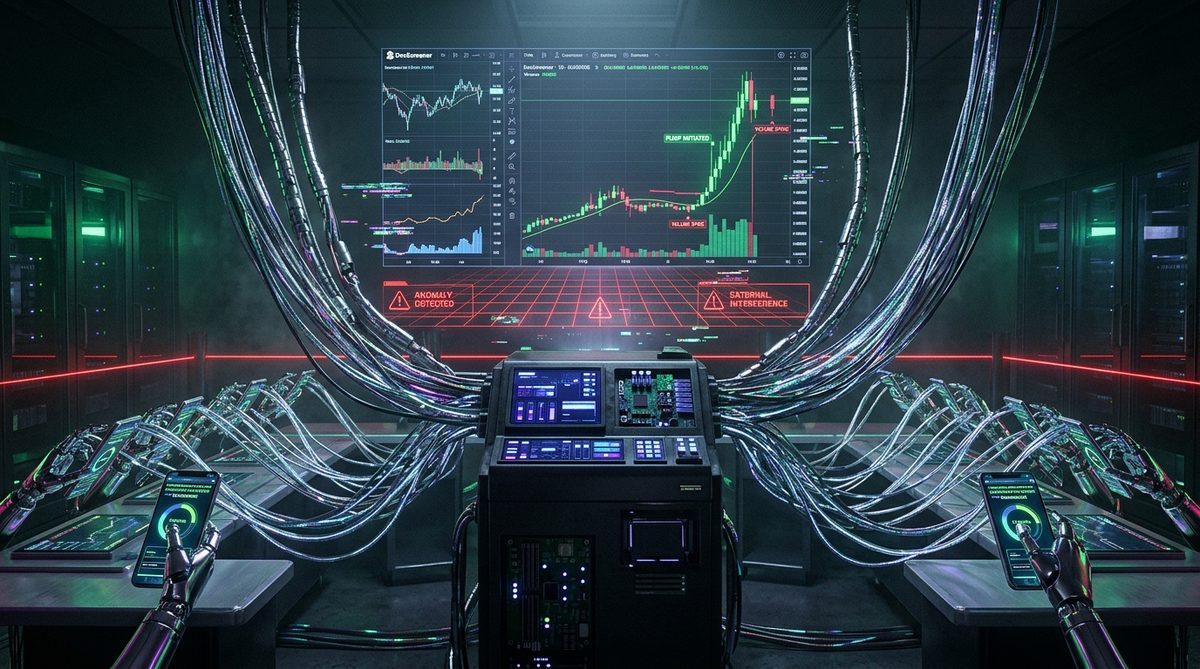
All too often, that vibrant ecosystem is completely synthetic. Scammers run automated multi-wallet Wash-Trading Scripts designed specifically to game charting ranking algorithms and trap unsuspecting retail buyers.
How Fake Maker Clusters Are Engineered
Modern charting aggregators like DexScreener, Birdeye, and GeckoTerminal rank trending tokens using algorithms that evaluate volume velocity and unique active wallet addresses. Scammers exploit these ranking parameters through structured bot networks:
- Sub-Wallet Spawning: The scammer funds a master wallet and uses automated keypair generation scripts to spin up 50 to 200 fresh child wallets. Each child wallet is funded with a fraction of a SOL (e.g., 0.1 to 0.5 SOL).
- The Circular Micro-Swap Loop: The script commands Child Wallet 1 to buy 0.2 SOL of the token. Seconds later, Child Wallet 2 sells 0.2 SOL back to the liquidity pool. The script continuously cycles funds across all 200 wallets throughout the day.
- Gaming the Maker Metric: Because every transaction originates from a distinct public address, the charting platform registers each transaction as a new unique "Maker." The token climbs directly onto the coveted top-3 trending bar.
- The Liquidity Reality: While the cumulative volume counter displays millions of dollars, net capital inflow is virtually zero. The pool remains dangerously thin, waiting for real retail investors to provide genuine exit liquidity for the developer.
Three Telltale Signs of Fabricated Activity
Traders can identify synthetic volume clusters by watching for these structural anomalies:
- Uniform Order Sizing: Real retail traders buy random, messy amounts (e.g., 0.37 SOL, 1.42 SOL, 5.81 SOL). Wash bots repeatedly fire round, uniform numbers (e.g., exactly 0.25 SOL or 0.50 SOL) across hundreds of transactions.
- The Ghost Community: The chart displays 10,000 unique swaps, but the project's Telegram chat has only 60 quiet members and Twitter mentions are completely silent.
- Circular Funding Trees: Tracing the transaction history of top buyers reveals that the vast majority were funded by the exact same central wallet within a 10-minute window prior to launch.
Uncover Synthetic Networks with RugPullShield
Evaluating wallet funding trees and transaction distributions manually takes far too long during fast-moving market sessions. RugPullShield automates on-chain cluster forensics.
Our scanner analyzes wallet creation timestamps, maps funding sources back to root wallets, and calculates maker authenticity scores in seconds. Verify true market demand and avoid trading into manufactured ghost towns.