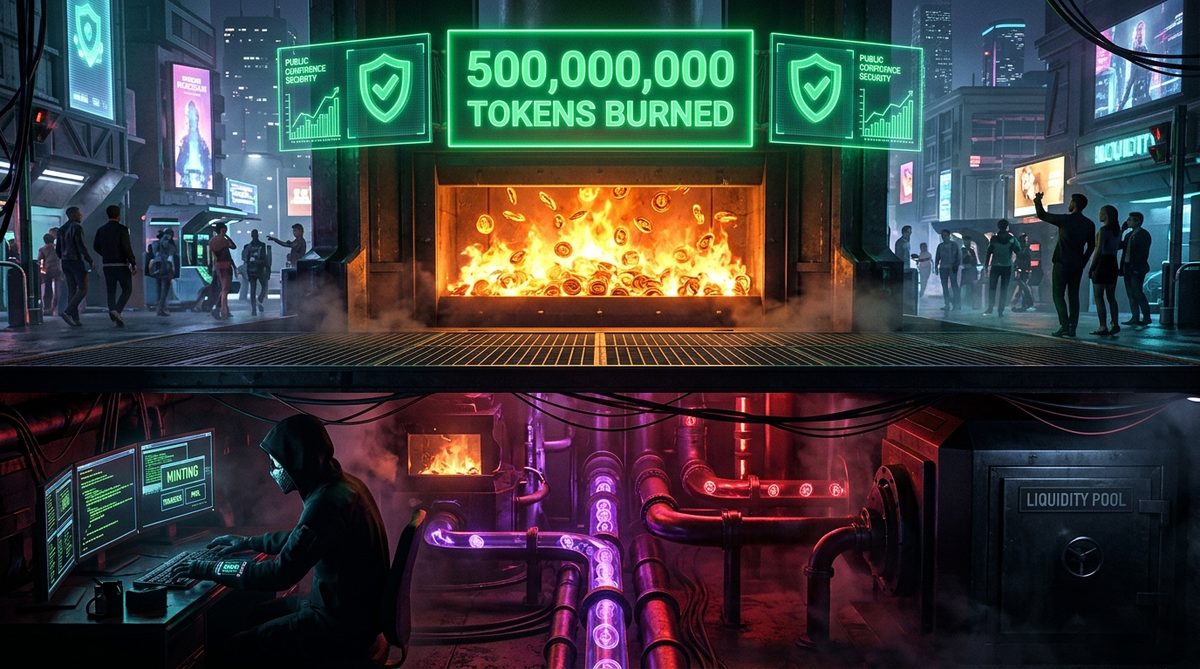
The Theater of Burning
In decentralized finance, token burns are treated as the holy grail of bullish catalysts. When an announcement shows that 500 million tokens were transferred to the official Solana Incinerator address, trading volume surges. Investors celebrate the reduction in circulating supply, anticipating immediate upward price pressure as tokens become scarce.
However, an emerging scam on Solana turns genuine burn events into a deceptive distraction: the Fake Supply Burn Trap. The developer actually burns real tokens to earn public praise, but conceals an unrevoked backdoor mechanism that prints double the burned amount directly into the liquidity pool.
How the Hidden Minting Trap Operates
To pull off this deception, scammers exploit the gap between basic wallet trackers and deep smart contract audits:
- The Legitimate Public Burn: The developer takes 50% of the initial circulating supply and burns it directly via the Solana Incinerator address. The transaction signature is 100% genuine and passes verification on Solscan, creating an explosion of community trust.
- The Concealed Programmatic Mint: While the developer publicly claimed the mint was finished, they routed token minting through a custom Anchor smart contract or wrapped Token-2022 extension account. Inside the contract code sits an unannounced instruction that permits the developer to execute a secondary mint directly into an automated market maker pool without altering standard SPL account flags.
- The Stealth Dilution Dump: Once retail buyers push the token's market cap to multi-million dollar levels based on the deflationary narrative, the developer invokes the secondary mint instruction. Hundreds of millions of fresh tokens are minted directly into the Raydium pool and swapped for SOL, crashing the price by 90% while holders wonder where the phantom supply came from.
Why Standard Explorers Miss the Exploit
Most traders verify token safety by looking at the top-level mint_authority line on Solscan. If it says Disabled, they assume no new tokens can ever exist. What basic explorers fail to analyze is whether the mint authority was transferred to an external smart contract before being revoked, or whether custom extension programs hold delegated mint rights.
Deep On-Chain Forensics with RugPullShield
True security requires looking past promotional burn events and auditing the underlying bytecode. RugPullShield inspects the entire architectural lifecycle of every scanned token.
Our scanner analyzes program delegation structures, audits historical instruction trees back to block zero, and verifies whether secondary mint authorities linger in connected smart contracts. Verify real scarcity with RugPullShield before risking your capital on theatrical burns.