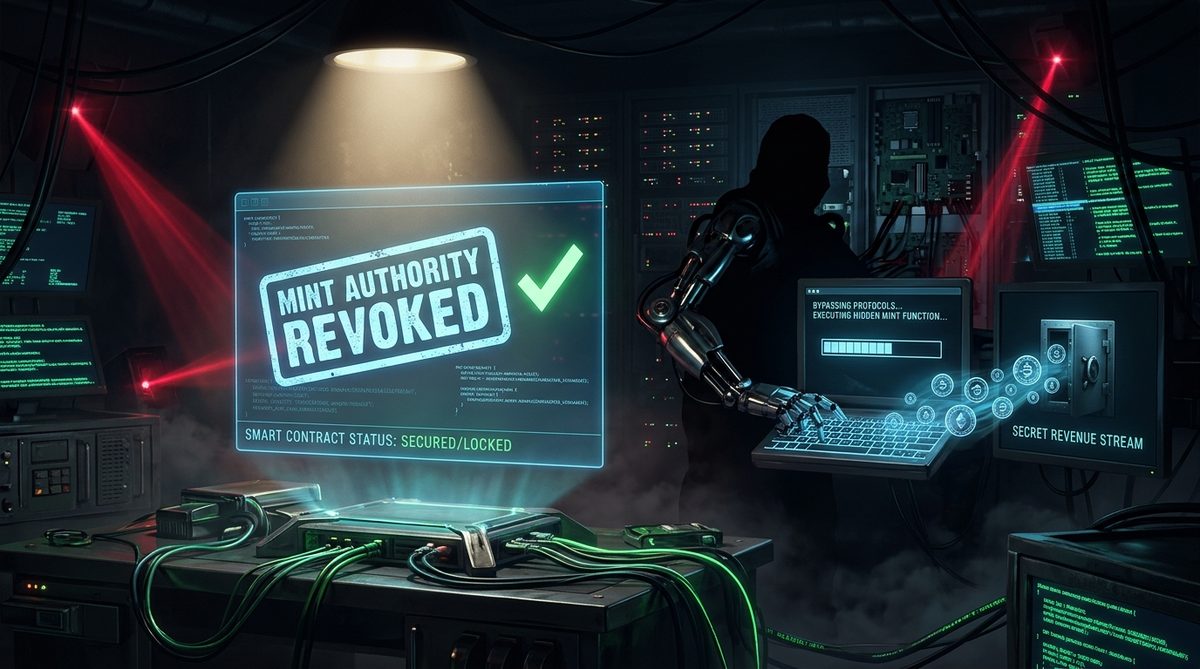
The False Security of Revocation
Every Solana trader knows the cardinal rule of token safety: never buy a token unless the Mint Authority is revoked. When an on-chain explorer like Solscan confirms that mint_authority is set to null, investors celebrate. A revoked mint implies that the supply is mathematically capped forever, eliminating the risk of developer inflation.
However, sophisticated scammers have developed an insidious method to create the illusion of revocation while quietly maintaining the ability to dilute the market: the Fake Revoke Exploit.
How the Secondary Keypair Trick Functions
In standard SPL tokens, mint authority is singular. But under complex deployment architectures and custom protocol wrappers, developers can engineer deceitful supply mechanics:
- The Pre-Minted Secondary Vault: Before revoking the public mint authority, the developer mints an additional 30% of the total supply into an unverified, secondary program-derived vault. They then publicly execute the
SetAuthorityinstruction to revoke the mint key. Block explorers display a clean green checkmark, but the stealth supply is already staged in the shadows. - The Wrapped Mint Delegation: Some malicious contracts route mint permissions through a custom intermediary Anchor smart contract. The developer revokes their personal wallet's direct authority over the mint, but the intermediary contract retains internal programmatic minting instructions controlled by an encrypted administrative seed.
- The Timed Supply Influx: Once the token gains viral traction on DexScreener and liquidity grows deep, the developer triggers their hidden contract instructions. Thousands of fresh tokens flood the market, crashing the price and draining investor capital while the core mint account still falsely reads as revoked.
Why Basic Explorers Miss the Exploit
Standard block explorers only check the top-level state of the SPL Mint Account. If the field reads None, the explorer declares the token safe. Basic scanners do not trace transaction trees back to slot zero or audit external smart contract wrappers governing historical supply generation.
Deep On-Chain Forensics with RugPullShield
Relying on a superficial green checkmark is no longer enough to protect your capital. RugPullShield performs comprehensive historical static analysis on every scanned token.
Our security engine traces token creation back to the initial deployment block, auditing all historical mint instructions, linked custody contracts, and stealth vault allocations. We reveal whether the supply was truly capped or if hidden secondary keypairs threaten your portfolio.