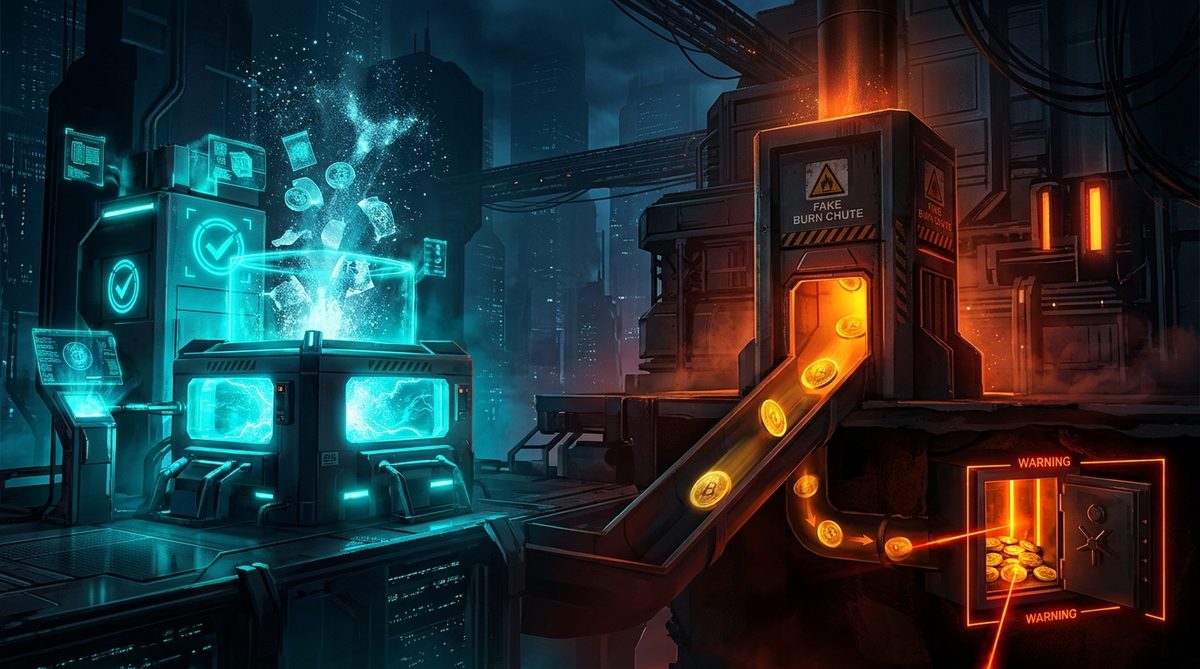
The Illusion of Destruction
In cryptocurrency tokenomics, burning tokens is the ultimate guarantee of supply reduction. When tokens are truly burned, they are permanently expunged from circulation, creating undeniable mathematical scarcity. For meme coin traders, proof of an initial supply burn or liquidity burn is one of the strongest bullish signals available.
However, as supply burns became a baseline requirement for investor trust, scammers engineered a deceptive sleight of hand: the Fake Burn Address Scam. Instead of permanently destroying the tokens, scammers send them to disposable burner wallets that look like dead addresses on casual inspection, retaining full cryptographic control to dump them later.
How the Fake Burn Deception Works
Scammers exploit the visual similarities between genuine null addresses and generated vanity wallets:
- The Lookalike Vanity Address: On Ethereum, burning usually involves sending assets to the iconic zero address (
0x000...dEaD). On Solana, scammers use GPU vanity address generators to brute-force addresses that start with strings like111111111111111111111111111111DeAdorBurn11111111111111111111111111111111. To an untrained trader glancing at a Solscan transfer, the destination address looks like a system incinerator. In reality, the developer holds the private key to that exact keypair. - The Transfer Instruction vs Native Burn: A genuine burn on Solana does not involve a standard transfer. It executes the native SPL Token
Burninstruction, which mathematically reduces thesupplyinteger recorded in the token mint account. In a fake burn, the developer simply executes a standardTransferinstruction to their lookalike wallet, leaving the total mint supply completely unchanged. - The Delayed Liquidation: Once the community pushes the market cap into the millions, believing 50% of the supply is gone forever, the developer quietly moves the tokens out of the "dead" wallet and dumps them into Raydium liquidity, crashing the price.
How to Verify a Real Token Burn on Solana
Protecting your capital against counterfeit burns requires verifying two on-chain metrics:
- Check the Mint Total Supply Integer: Open the token mint on Solscan or Solana FM. If 50% of the tokens were burned, the on-chain Total Supply field must reflect that reduction. If the total supply remains 1,000,000,000, no tokens were burned, regardless of transfer claims.
- Verify the Official Incinerator Address: The official, canonical Solana burn destination is the Solana Incinerator address:
1nc1nerator11111111111111111111111111111111. Assets sent here are permanently unrecoverable. - Look for the Native SPL Burn Instruction: Genuine burns trigger the protocol-level
burnCheckedorburninstruction, not a standard token transfer.
Automated Supply Auditing with RugPullShield
Manually tracking mint supply integers and parsing instruction logs for every new launch is time-consuming. RugPullShield automates supply verification directly from the Solana runtime.
Our scanner verifies whether token supply reductions were executed through native burn instructions or sent to verified incinerators, instantly flagging vanity burner wallets so you never fall victim to fake scarcity.