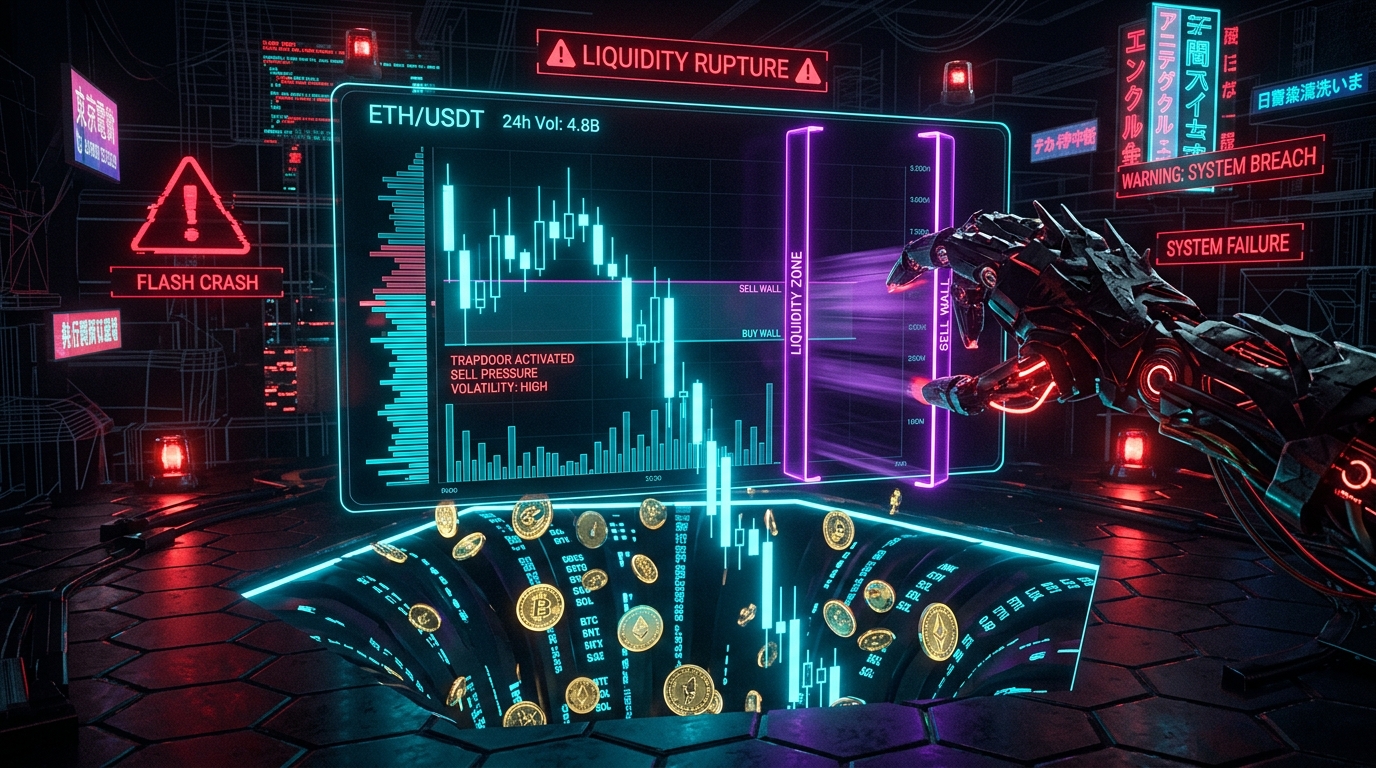
Beyond Standard Liquidity Pools
Most Solana traders know how a standard Constant Product AMM pool works: the developer pairs tokens with SOL across an infinite price curve from zero to infinity and burns the resulting LP tokens. Once burned, that liquidity can never be removed.
However, decentralized exchanges like Raydium (CLMM), Orca (Whirlpools), and Meteora (DLMM) also offer Concentrated Liquidity pools. Instead of spreading liquidity across all possible prices, liquidity providers allocate capital within specific price brackets (ticks). Scammers have turned this advanced DeFi feature into a stealth rug pull mechanism.
How the CLMM Range Rug Unfolds
In a Concentrated Liquidity pool, ownership of the liquidity is represented by an NFT position rather than fungible LP tokens. If a developer does not permanently lock that position NFT, they can manipulate the pool without executing a classic "Remove Liquidity" transaction that triggers basic bot alarms:
- Single-Sided Supply Trap: The developer creates a CLMM pool and places only 5 SOL on the buy side while loading millions of tokens into the upper price ticks. As retail buys in, the pool automatically converts the developer's tokens into SOL.
- Shifting the Active Range: Once the price climbs and the pool accumulates 100 SOL from retail buyers, the developer adjusts their concentrated range or closes the specific tick bracket holding the SOL, leaving zero SOL support underneath the current market price.
- The Air Pocket Crash: The next time a regular holder tries to sell even $50 worth of the token, the price falls straight through an empty liquidity air pocket, crashing 99% in a single swap.
What to Check Before Trading CLMM Pairs
When trading tokens hosted on Meteora DLMM or Raydium CLMM, keep these safety principles in mind:
- Verify Position NFT Locks: Check whether the creator's liquidity position NFT is held in a verified, immutable locking contract.
- Inspect Bid-Side SOL Depth: A pool might display $100,000 in total value locked (TVL), but $98,000 of that figure could be just the developer's own overvalued tokens sitting above the current price, with only $2,000 in real SOL supporting the floor.
Deep Pool Forensics with RugPullShield
Evaluating tick distribution and position NFT custody manually takes far too long during a fast market move. RugPullShield inspects the exact structure of Solana liquidity pools automatically.
Our scanner distinguishes between real SOL bid support and artificial token-heavy TVL, alerting you immediately if a creator retains control over concentrated liquidity ranges.