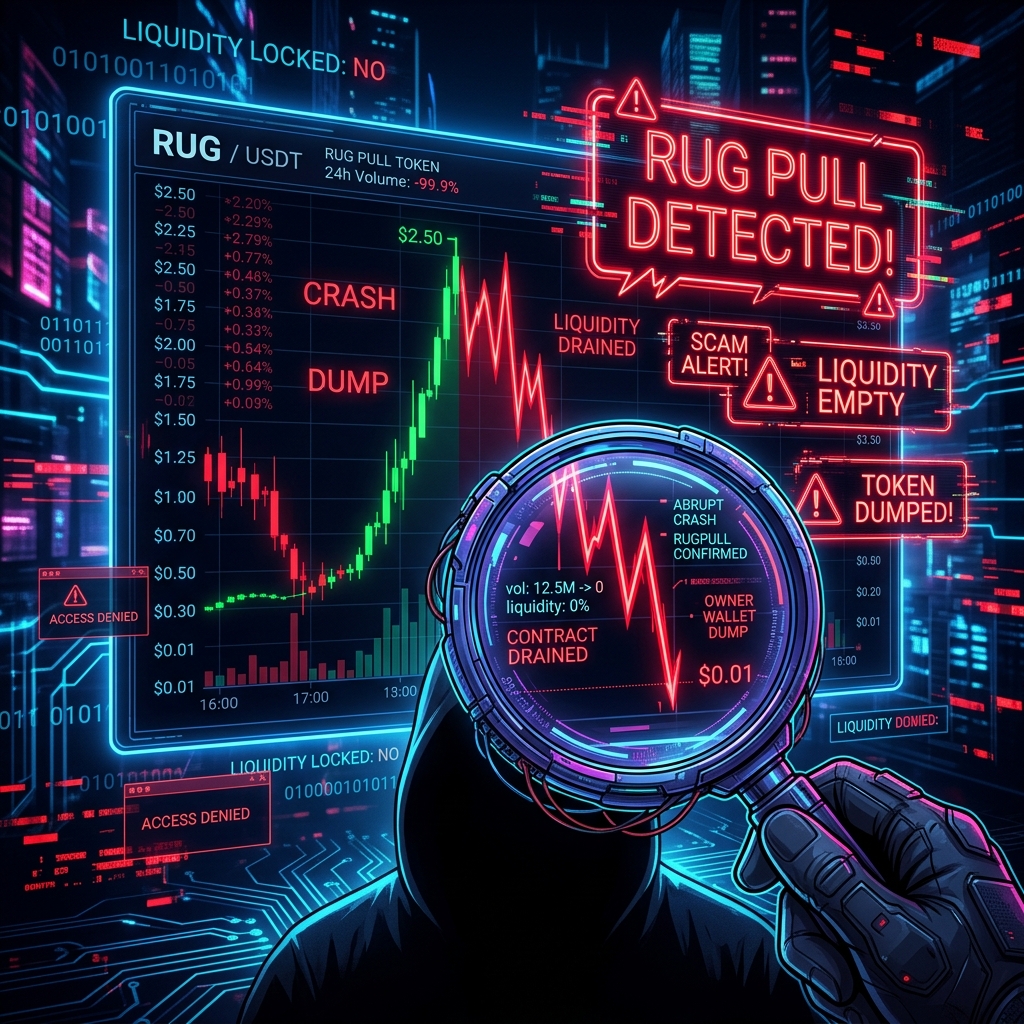
The Anatomy of a Modern Rug Pull on Pump.fun
The meme coin market on Solana moves at breakneck speed. Every single day, thousands of new tokens are launched on platforms like pump.fun and Raydium. While a few of these tokens skyrocket to multi-million dollar market caps, the harsh reality is that over 95% of them are designed from day one to steal your money. In this week’s autopsy, we are diving deep into three of the most sophisticated rug pulls we detected on pump.fun, breaking down exactly how the developers orchestrated their scams, the on-chain footprints they left behind, and how our proprietary scoring engine flagged them before the crash.
Case Study 1: The Coordinated Bundled Sniper
Our first case involves a token that initially looked like a dream launch. The moment the token went live on pump.fun, it saw massive buy volume. The chart looked incredibly bullish, drawing in hundreds of retail traders who didn't want to miss out on the next big runner.
However, what retail traders didn't see was the truth hidden in the blockchain data. The developer had used a highly sophisticated "bundler bot." Before the token even reached the public eye, the developer submitted a single, bundled transaction to the Solana validators. This transaction created the token and simultaneously executed 25 different buy orders from 25 fresh, unfunded wallets.
The Trap: By the time regular traders were able to buy their first tokens, the developer already controlled over 82% of the total circulating supply. The developer slowly bled the chart, selling off small chunks to avoid tanking the price instantly, completely draining the liquidity pool over the course of an hour.
How We Spotted It: RugPullShield's real-time engine doesn't just look at the chart; it analyzes wallet clustering. Our system detected that all 25 initial buyers were funded by the exact same centralized exchange address within minutes of each other. The token was flagged as HIGH RISK within 0.8 seconds of launch.
Case Study 2: The Fake Renounced Contract
In our second case, the scammers tried to build trust. They publicly announced that they had "burned the liquidity" and "renounced ownership" of the contract. To the untrained eye, verifying this on Solscan seemed to confirm their claims. The token started to pump organically.
The Trap: While the primary liquidity pool was indeed burned, the developer had hardcoded a hidden mint function within the token's metadata update authority. When the token reached a $1M market cap, the developer secretly minted millions of new tokens directly to their hidden wallet and dumped them on the Raydium pool, crashing the price to zero instantly.
How We Spotted It: Our static code analysis tool scans the raw bytecode of every token contract. It identified the anomalous mint authority that hadn't been properly revoked, overriding the "burned liquidity" metric and immediately issuing a warning.
Case Study 3: The Social Engineering Honeypot
The final case study wasn't a technical rug pull, but a social one. The token was heavily promoted by several prominent Twitter influencers simultaneously. The contract was clean, the liquidity was locked, and the distribution looked fair. It seemed impossible for a rug pull to occur.
The Trap: The token wasn't technically flawed, but it was a coordinated dump. The top 10 wallets, which appeared independent, were actually controlled by a syndicate of influencers. They waited for the token to trend on DexScreener, and once retail FOMO peaked, they market-sold their entire bags at the exact same second, completely wiping out the bid side of the order book.
How We Spotted It: While harder to detect technically, our engine monitors extreme concentration of holdings among top wallets and the velocity of transactions. The risk score was elevated to MODERATE RISK early on due to the supply concentration, and flipped to HIGH RISK moments before the coordinated dump began.
The Bottom Line
Scammers are evolving. They know that traders are looking for basic warning signs, so they engineer their scams to bypass superficial checks. This is why relying on manual checks or simple Telegram bots is no longer enough. You need comprehensive, real-time on-chain analysis to protect your portfolio.
Always verify the risk score before you make your next trade.